Statcounter

Saturday, 20 December 2014

Pierre-Yves Girard at Galerie D'Este.

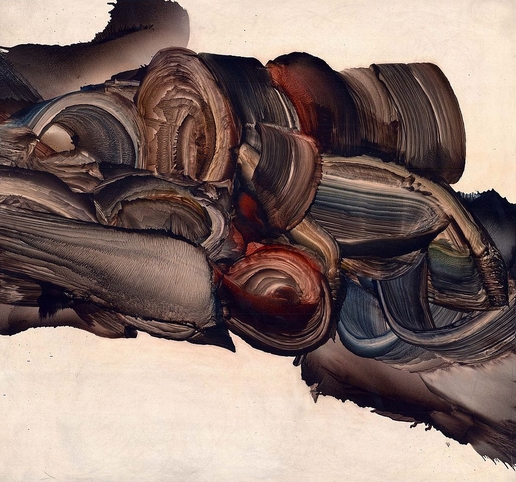
PIierre-Yves Girard - Écorceur de pruches,
Pierre-Yves Girard - Écorceur de pruches

Pierre-Yves Girard's paintings take up the corner of Galerie D'Este's end of year show. A strong and lush brown to blue palette with tinges of blood red circulates and unfolds throughout his swirling oil paintings. A good sense of contracting and releasing torsion in a few, particularly the verticals. The paintings orchestrated on the horizontal lose much of this. Their rendering is looser, the composition less clear. Rather than being dynamic, they tend to thud. This is a bit tragi-comic; a set of convulsions registered as smears that shadow action. But this delicacy, often verging on failure, is damaged by his frequent spattering of black dots that muddy up the negative space around his cautiously manipulated zones. More carefully applied, they might have provided a certain degree of ironic displacement for the central gestures. Instead, they come off as less uncertain and more distracted: too much of too little.

Friday, 19 December 2014

Kent Monkman's Urban Res at PFOAC.

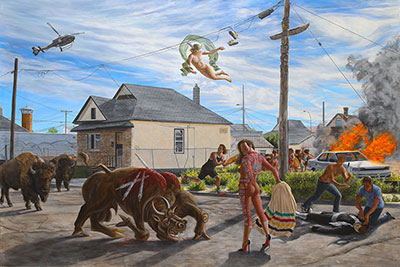
Kent Monkman - Red
Kent Monkman - Red

I have to admit that I've always been ambivalent about Kent Monkman's work. That hasn't changed, but I've finally found a way to look at it and not see it as tedious. Monkman, winner of the Hnatyshyn 2014 Prize for excellence in the visual arts and winner of 2014 Indspire Award, has been the poster child (or pin-up girl) for politicized art in the country for awhile. His latest exhibit, Urban Res, at PFOAC displays homoerotic aboriginal youths with tattooed angels, spirit warriors, figures from Picasso and Francis Bacon, all running riot in what appears to be Manitoba. It plays on images of Christian martyrdom and echoes some of Attila Lukacs' earlier work. By coincidence, it also benefits from the imagery of the latest racial fiascoes south of the border to have become the fodder for an orgy of televised and online stupidity. I mention this largely because the sizable volume of writings to accumulate around Monkman tends to replay many of the same underlying moral and political arguments, albeit in more domesticated, if no less pretentious, tones.