Statcounter

Showing posts with label Canadian art. Show all posts

Tuesday, 13 January 2015

Simon Bilodeau at Art Mur.

simon_11
Ce que l’on ne voit pas qui nous touche pile #1, 2014

L'arc-en-ciel n'existe pas

Montreal artist Simon Bilodeau's latest show at Art Mur is something of a culmination of many of the tendencies that have been present in his work for more than half a decade. Unlike other artists who concentrate on 'materiality', Bilodeau's is a resolutely cold sensibility devoid of any of the touchy-feely aesthetic touches that plague so much current abstract work. He constructs mausoleums, not party spaces. Bilodeau has said, Par ce choix plastique de n’utiliser aucune couleur, je consens à ne susciter aucune émotion par les couleurs utilisées, puisque celles-ci, je crois, tendraient par comparaison à prendre pour réalité ce qui est présenté. (By the choice not to use any plastic colour, I agree not to provoke any emotion by the colours used, since they, I think, tend to take compared to what is actually presented.) Which is to say, the painting (or sculpture) negates the emoticon function for the sake of the image.

Wednesday, 7 January 2015

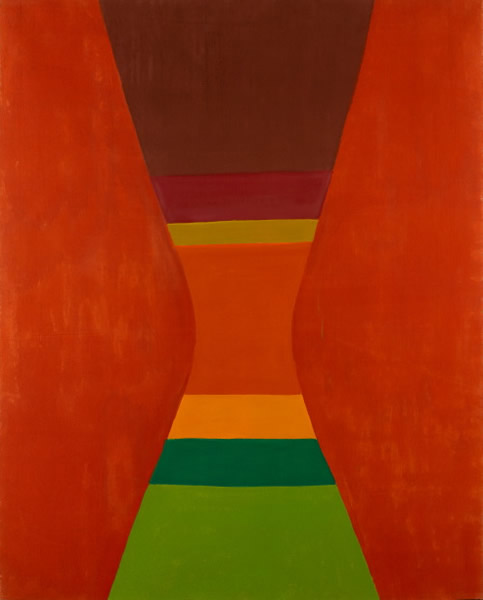
Jack Bush at the National Gallery of Canada.

Pinched Orange, 1964

The 2014 Biennial was bland. Even Mario Doucette's work couldn't lift it from feeling like a recycled lump. But it isn't as though the NGC was putting it in serious competition with their major show, the Jack Bush Retrospective, co-curated by Marc Mayer and Sarah Stanners. The show is big, perhaps too much so, and impressive. It's not impressive just because it's big, thankfully, although that's usually a significant help to it. For example, when the many rooms that make up the show open up into each other, when you can stand in a position and glance one direction to another to survey years of work in either linear path, there's a kind of overwhelming impressiveness. This linearity, which is chronological, is essential to the show and the workman-like quality that it gives to Bush's works.

Saturday, 20 December 2014

Pierre-Yves Girard at Galerie D'Este.

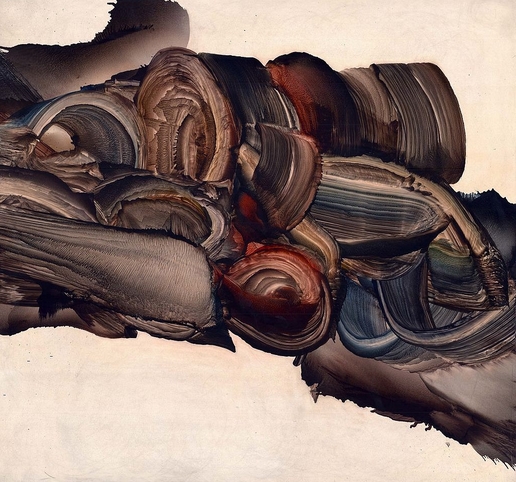
PIierre-Yves Girard - Écorceur de pruches,
Pierre-Yves Girard - Écorceur de pruches

Pierre-Yves Girard's paintings take up the corner of Galerie D'Este's end of year show. A strong and lush brown to blue palette with tinges of blood red circulates and unfolds throughout his swirling oil paintings. A good sense of contracting and releasing torsion in a few, particularly the verticals. The paintings orchestrated on the horizontal lose much of this. Their rendering is looser, the composition less clear. Rather than being dynamic, they tend to thud. This is a bit tragi-comic; a set of convulsions registered as smears that shadow action. But this delicacy, often verging on failure, is damaged by his frequent spattering of black dots that muddy up the negative space around his cautiously manipulated zones. More carefully applied, they might have provided a certain degree of ironic displacement for the central gestures. Instead, they come off as less uncertain and more distracted: too much of too little.

Friday, 19 December 2014

Kent Monkman's Urban Res at PFOAC.

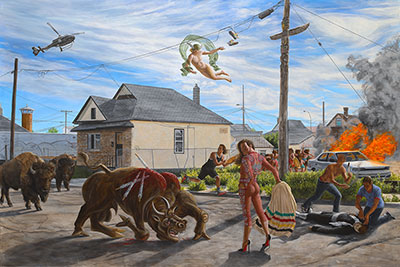
Kent Monkman - Red
Kent Monkman - Red

I have to admit that I've always been ambivalent about Kent Monkman's work. That hasn't changed, but I've finally found a way to look at it and not see it as tedious. Monkman, winner of the Hnatyshyn 2014 Prize for excellence in the visual arts and winner of 2014 Indspire Award, has been the poster child (or pin-up girl) for politicized art in the country for awhile. His latest exhibit, Urban Res, at PFOAC displays homoerotic aboriginal youths with tattooed angels, spirit warriors, figures from Picasso and Francis Bacon, all running riot in what appears to be Manitoba. It plays on images of Christian martyrdom and echoes some of Attila Lukacs' earlier work. By coincidence, it also benefits from the imagery of the latest racial fiascoes south of the border to have become the fodder for an orgy of televised and online stupidity. I mention this largely because the sizable volume of writings to accumulate around Monkman tends to replay many of the same underlying moral and political arguments, albeit in more domesticated, if no less pretentious, tones.

Thursday, 18 December 2014

Luke Painter's Hither and Thither at Galerie Trois Points.

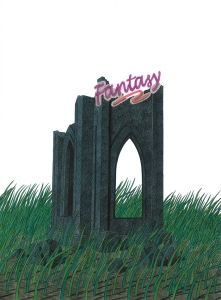
fantasy_02
Luke Painter - Fantasy 02
There's something too restrained about Luke Painter's ink on paper works displayed at Galerie Trois Points. They manage to be not quite lively enough to be successfully decorative and yet still not quite developed enough to be the backgrounds for a graphic novel. There's not enough atmosphere for either. A sense of expressionistic set design runs throughout the pieces. He even titles one Blue Room (Dark Italics Dr Caligri). It is reminiscent of Weine's classic film (though perhaps more of Laughton's The Night Hunter sets). To up the ante, he sets the work in a slanted frame (thus italic). This underlining of his images points more to what they are missing than to anything else. They don't express much, they just stage it. What results from this is an oddity: spaces without place. They are one liners that run in a vacuum of unlimited time. There's something interesting about that. I can't imagine what it is. That's what's interesting... the not imagining of the image. If, in practice, this often makes them come off like throwaway set designs from a forgettable 80s kids movie (Gardens [Basilius Besler] is reminiscent of some of the sets of Return to Oz) or a no budget dystopian fantasy, it also makes them strangely close to Minimalism. The best summary of the show is probably Fantasy 02 which provides both the overgrown yet wispy vegetation he seems fond of with romantic Gothic ruins and a gaudy sign that could be from a strip club or a Bruce Nauman. However, his restraint, his overbearing push to being not quite something or other, dissolves any tension that his compositions could hold and leaves them feeling flatter than wallpaper.

Saturday, 29 November 2014

On Bertram Brooker.

Brooker_painting
Glamour of the Underfolk.
"There is so much heat in my heart, that Humanity cannot escape being scorched, no man shall escape the heat of my heart. [...] I am the overflowing scourge whom God has sent down to chasten the earth. [...] I am the champion of the Underfolk." (Brooker, 155-156)
Unlike the majority of Canadian artists working in the first half of the twentieth century, Bertram Brooker wrote voluminously about his own work and that of his contemporaries, expounding and elaborating his aesthetic theories in different milieus. His attempt to articulate a peculiarly Canadian form of Modernism that could respond to the demands of his adopted nation frequently involved a mildly antagonistic engagement with the specifically English strains of Modernism, embodied, at least in his mind, by Wyndham Lewis, who he refers to as a pessimistic and reactionary humanist (Brooker, 215). And while the influence of Vorticism is clearly present in much of his work, and the critique of the Time Cult is also echoed, Brooker's answer to the issues which Lewis raised were very much his own.

Thursday, 13 November 2014

Of Alex Colville.

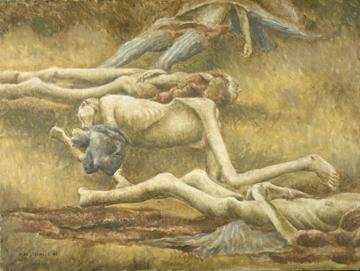
19710261-2033_belsen-grave_a-colville
Bodies in a grave, Belsen (1946)
A retired war artist who had documented the acceleration of technology and the destruction of flesh, both around battlefields and in Auschwitz, Alex Colville abandoned the figure for years after the Second World War. He finally re-introduced it with a series of nude, Grace type figures, dotting the shore to which he had returned. As his career progressed, Colville drew far closer to the technological theodicy promulgated by Marshall McLuhan, carrying on the vitalist fantasies of Bertram Brooker. Like the latter, and for much the same reasons, he regarded his work as a very special kind of primitivism, claiming that his own work has the "characteristics of an essentially unsophisticated, that is to say, primitive art" (quoted in Burnett 18) one which was intrinsically bound to a spiritual understanding of a new and technologically advanced world. But where Brooker's figures exuded a vital quality that radiated through space and frequently fragmented it, Colville's are only devices for measurement that flatten the figure as an 'arrested happening' (Dow 127) intended to testify to the eternity of Being: The hallucinatory re-codification of space and time with the irreality of a neo-Thomist theodicy. And yet, in spite of Colville's (and many of his commentators') insistence on the unity, harmony and measure of his work, built right into this hallucination of eternal order is its immanent collapse. And it is this, as much as the tension which he manages in the ambiguous, decontextualized moments he creates, that causes a further problem, one less moral than logico-mathematical.

Wednesday, 30 April 2014

Ruth B. Phillips: Piety and Propaganda.

Professor-Ruth-Phillips

For Ruth B. Phillips, the museum functions as a 'diagnostic' device for 'Western modernity' as it progressively displaces the religious sphere as the domain of art.1 In its place is erected a monument to secularism, the establishment of the nation state and the domination of indigenous people. This is the backdrop she draws for her polemical article "A Proper Place for Art or the Proper Arts of Place? Native North American Objects and the Hierarchies of Art, Craft, and Souvenir." From her first sentences, Phillips spells out the ideological claim she's staking. Note that she uncritically naturalizes 'indigenous systems of spirituality, expressive culture, and value' while insisting on the artificial quality of 'idealist notions of art and scientific paradigms of objecthood'.2 In effect, 'Western' could be understood in her lexicon as artifice, variously regarded as a 'mystification' and 'commoditization' process. Therefore, when she comes to speak of cultural hybridization, a substantial part of what she is insisting on is the entrance of a previously non-capitalist culture into the international market. What her article struggles with is the nature of this reterritorialization.