Statcounter

Showing posts with label art. Show all posts

Tuesday, 13 January 2015

Simon Bilodeau at Art Mur.

simon_11
Ce que l’on ne voit pas qui nous touche pile #1, 2014

L'arc-en-ciel n'existe pas

Montreal artist Simon Bilodeau's latest show at Art Mur is something of a culmination of many of the tendencies that have been present in his work for more than half a decade. Unlike other artists who concentrate on 'materiality', Bilodeau's is a resolutely cold sensibility devoid of any of the touchy-feely aesthetic touches that plague so much current abstract work. He constructs mausoleums, not party spaces. Bilodeau has said, Par ce choix plastique de n’utiliser aucune couleur, je consens à ne susciter aucune émotion par les couleurs utilisées, puisque celles-ci, je crois, tendraient par comparaison à prendre pour réalité ce qui est présenté. (By the choice not to use any plastic colour, I agree not to provoke any emotion by the colours used, since they, I think, tend to take compared to what is actually presented.) Which is to say, the painting (or sculpture) negates the emoticon function for the sake of the image.

Wednesday, 7 January 2015

Jack Bush at the National Gallery of Canada.

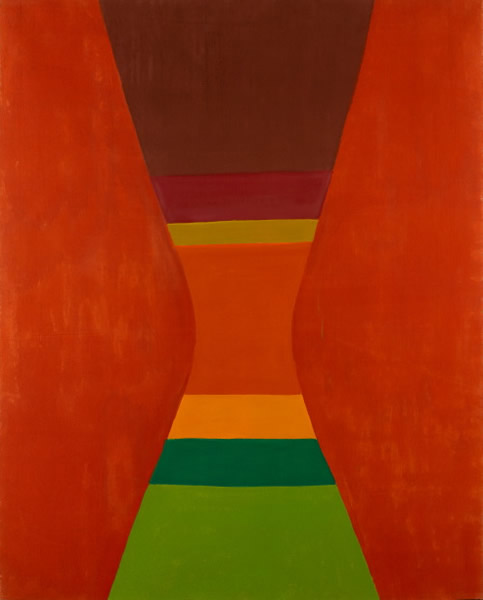
Pinched Orange, 1964

The 2014 Biennial was bland. Even Mario Doucette's work couldn't lift it from feeling like a recycled lump. But it isn't as though the NGC was putting it in serious competition with their major show, the Jack Bush Retrospective, co-curated by Marc Mayer and Sarah Stanners. The show is big, perhaps too much so, and impressive. It's not impressive just because it's big, thankfully, although that's usually a significant help to it. For example, when the many rooms that make up the show open up into each other, when you can stand in a position and glance one direction to another to survey years of work in either linear path, there's a kind of overwhelming impressiveness. This linearity, which is chronological, is essential to the show and the workman-like quality that it gives to Bush's works.

Thursday, 18 December 2014

Luke Painter's Hither and Thither at Galerie Trois Points.

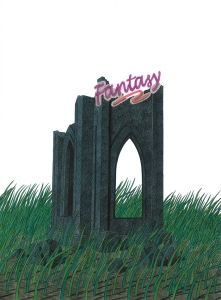
fantasy_02
Luke Painter - Fantasy 02
There's something too restrained about Luke Painter's ink on paper works displayed at Galerie Trois Points. They manage to be not quite lively enough to be successfully decorative and yet still not quite developed enough to be the backgrounds for a graphic novel. There's not enough atmosphere for either. A sense of expressionistic set design runs throughout the pieces. He even titles one Blue Room (Dark Italics Dr Caligri). It is reminiscent of Weine's classic film (though perhaps more of Laughton's The Night Hunter sets). To up the ante, he sets the work in a slanted frame (thus italic). This underlining of his images points more to what they are missing than to anything else. They don't express much, they just stage it. What results from this is an oddity: spaces without place. They are one liners that run in a vacuum of unlimited time. There's something interesting about that. I can't imagine what it is. That's what's interesting... the not imagining of the image. If, in practice, this often makes them come off like throwaway set designs from a forgettable 80s kids movie (Gardens [Basilius Besler] is reminiscent of some of the sets of Return to Oz) or a no budget dystopian fantasy, it also makes them strangely close to Minimalism. The best summary of the show is probably Fantasy 02 which provides both the overgrown yet wispy vegetation he seems fond of with romantic Gothic ruins and a gaudy sign that could be from a strip club or a Bruce Nauman. However, his restraint, his overbearing push to being not quite something or other, dissolves any tension that his compositions could hold and leaves them feeling flatter than wallpaper.

Saturday, 29 November 2014

On Bertram Brooker.

Brooker_painting
Glamour of the Underfolk.
"There is so much heat in my heart, that Humanity cannot escape being scorched, no man shall escape the heat of my heart. [...] I am the overflowing scourge whom God has sent down to chasten the earth. [...] I am the champion of the Underfolk." (Brooker, 155-156)
Unlike the majority of Canadian artists working in the first half of the twentieth century, Bertram Brooker wrote voluminously about his own work and that of his contemporaries, expounding and elaborating his aesthetic theories in different milieus. His attempt to articulate a peculiarly Canadian form of Modernism that could respond to the demands of his adopted nation frequently involved a mildly antagonistic engagement with the specifically English strains of Modernism, embodied, at least in his mind, by Wyndham Lewis, who he refers to as a pessimistic and reactionary humanist (Brooker, 215). And while the influence of Vorticism is clearly present in much of his work, and the critique of the Time Cult is also echoed, Brooker's answer to the issues which Lewis raised were very much his own.

Thursday, 13 November 2014

Of Alex Colville.

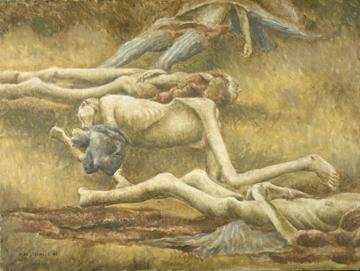
19710261-2033_belsen-grave_a-colville
Bodies in a grave, Belsen (1946)
A retired war artist who had documented the acceleration of technology and the destruction of flesh, both around battlefields and in Auschwitz, Alex Colville abandoned the figure for years after the Second World War. He finally re-introduced it with a series of nude, Grace type figures, dotting the shore to which he had returned. As his career progressed, Colville drew far closer to the technological theodicy promulgated by Marshall McLuhan, carrying on the vitalist fantasies of Bertram Brooker. Like the latter, and for much the same reasons, he regarded his work as a very special kind of primitivism, claiming that his own work has the "characteristics of an essentially unsophisticated, that is to say, primitive art" (quoted in Burnett 18) one which was intrinsically bound to a spiritual understanding of a new and technologically advanced world. But where Brooker's figures exuded a vital quality that radiated through space and frequently fragmented it, Colville's are only devices for measurement that flatten the figure as an 'arrested happening' (Dow 127) intended to testify to the eternity of Being: The hallucinatory re-codification of space and time with the irreality of a neo-Thomist theodicy. And yet, in spite of Colville's (and many of his commentators') insistence on the unity, harmony and measure of his work, built right into this hallucination of eternal order is its immanent collapse. And it is this, as much as the tension which he manages in the ambiguous, decontextualized moments he creates, that causes a further problem, one less moral than logico-mathematical.

Monday, 20 October 2014

Notes: On the rudiments of culture

OLYMPUS DIGITAL CAMERA  

From The Infanticidal Logic of Evolution and Culture by A. Samuel Kimball. Not a popular book by any means, but essential reading for the too often ignored basics.
The infanticidal implications of reproductive success, easy enough to demonstrate, are burdensome to accept, for they signal the mistakenness of the common belief that evolution is principally the set of processes by which life proliferates. To the contrary, evolutionary change gives rise to life only as that life economizes on - lives off of by destroying- itself within a thermodynamic horizon that condemns all living things to extinction. (42)
Evolution is economization; economization is sacrificial because it necessitates the deflection of costs onto others and the environment. What's more, this sacrifice is intrinsically infanticidal following the thermodynamic limit imposed by the evolutionary economy. Infanticide destroys lineages singly and collectively, in the present and into the future. This economy entails not only these ends, but "the inevitable end of life itself." (37) Terrestrial vital existence is axiomatically ruled by these principles. "The evolutionary program knows no other economy, and the economy it does know is sacrificial." (38)

E-catalogue for Rory Dean's The Bassoonist

Get it here. From The Petrified Forest Gallery. With essays by yours truly and Joe Becker.

Saturday, 23 August 2014

Jared Peters’ Just as it should be at the McIntosh Gallery.

mcg-homepage-mfa2014
Surrealist of the bland unconscious
Car seats, toilets, bars of soap, sinks and industrial tiles. These are the dominant subjects of Jared Peters' Just as it should be at the McIntosh Gallery. Toilet is indicative of the show as a whole. Muted in colour, geometrical but soft on line and sitting with slight unease in a boxy but not quite square canvas space. It's a lot of not quite ball-in-a-box. Viewed from above, the toilet has only a subtle sense of depth. Like the sink in the painting beside it, the flattening wins out. With careful attention to the detail of floor tiles, it is also the decorative which dominates. This is only accented by the striking lack of any excretion in the toilet: just the twists of some paper rendered like the wrinkles of a shirt. While the clean/filth divide has been fairly overstated by anthropologists since at least Mary Douglas' seminal, if simplistic, Purity and Danger, there is remarkably little of the latter in evidence. Instead, it's a world so decontaminated that the only sense of life is the murkiness of its colour scheme.

Wednesday, 23 July 2014

Letter from Montreal (July).

Dear X.,

Just returned from Montreal. The weather was less terrible than usual in July. The streets more clotted than ever by tourists. Yet, it still smells less horrible than most Canadian cities. The food is still good. My French is still bad. The flavour of beers more unique and more disappointing. Many galleries were closed to avoid the congestion. The John Heward show at Galerie Roger Bellemare was much like every other Heward show Iꞌve seen. They were mostly called masks or self portraits. Usually weighed down by metal clips. This was an unconvincing gesture but hinted that they may have had another life. Rags and lilting flags. The occasional reference in a title to spice things up. They are the remains of a shipwreck that never had a ship. But they were nicely laid out in the gallery. Across the hall were a few striking pieces by Angele Verret. Enjoyably irritating, mildly hallucinatory.

Thursday, 10 July 2014

Dave Kemp: The things you know but cannot explain at The McIntosh Gallery.

Dave Kempꞌs PHD exhibition The things you know but cannot explain at The McIntosh Gallery includes two sets of photographs, a video series and one long-playing video work. One set of images were taken using the one pixel camera which the artist designed and built. Its severe restrictions create monochromes which are actually captures of deliberately clichéd subject matter (sunsets, birthday parties, Niagara Falls etc.). Facing these images is the Locations series which pictures banal landscapes, unremarkably composed and framed. The video works all play on boredom: watching water boil, watching paint dry, watching the grass grow etc. These idiomatic capsules of boredom are rendered literally and played out in time. The idiomatic aspect insists on their familiarity. Their literalizing seeks to actualize the rhetoric, passing from figure to phenomena.

Wednesday, 4 June 2014

Walter Benjamin sells magic beans

soft-construction-with-boiled-beans-premonition-of-civil-war(1)

In Walter Benjamin's Little History of Photography, he contrasts three kinds of photography: art or creative photography, fairground 'huckster' photography and industrial photography. The middle form he largely abandons to set up a tidy duality. He speculates that the return of the former in the early twentieth century may be linked to a capitalist crisis (507) and equates it with 'philistine' (508) conceptions of art. Benjamin suggests that the philistine reacts in abject terror when technology is posed to erode their romantic conception of genius. He then recasts the photographer in the equally romantic role of the 'overturner' of art-fetishism who could unleash unanticipated effects.

Wednesday, 30 April 2014

Ruth B. Phillips: Piety and Propaganda.

Professor-Ruth-Phillips

For Ruth B. Phillips, the museum functions as a 'diagnostic' device for 'Western modernity' as it progressively displaces the religious sphere as the domain of art.1 In its place is erected a monument to secularism, the establishment of the nation state and the domination of indigenous people. This is the backdrop she draws for her polemical article "A Proper Place for Art or the Proper Arts of Place? Native North American Objects and the Hierarchies of Art, Craft, and Souvenir." From her first sentences, Phillips spells out the ideological claim she's staking. Note that she uncritically naturalizes 'indigenous systems of spirituality, expressive culture, and value' while insisting on the artificial quality of 'idealist notions of art and scientific paradigms of objecthood'.2 In effect, 'Western' could be understood in her lexicon as artifice, variously regarded as a 'mystification' and 'commoditization' process. Therefore, when she comes to speak of cultural hybridization, a substantial part of what she is insisting on is the entrance of a previously non-capitalist culture into the international market. What her article struggles with is the nature of this reterritorialization.